


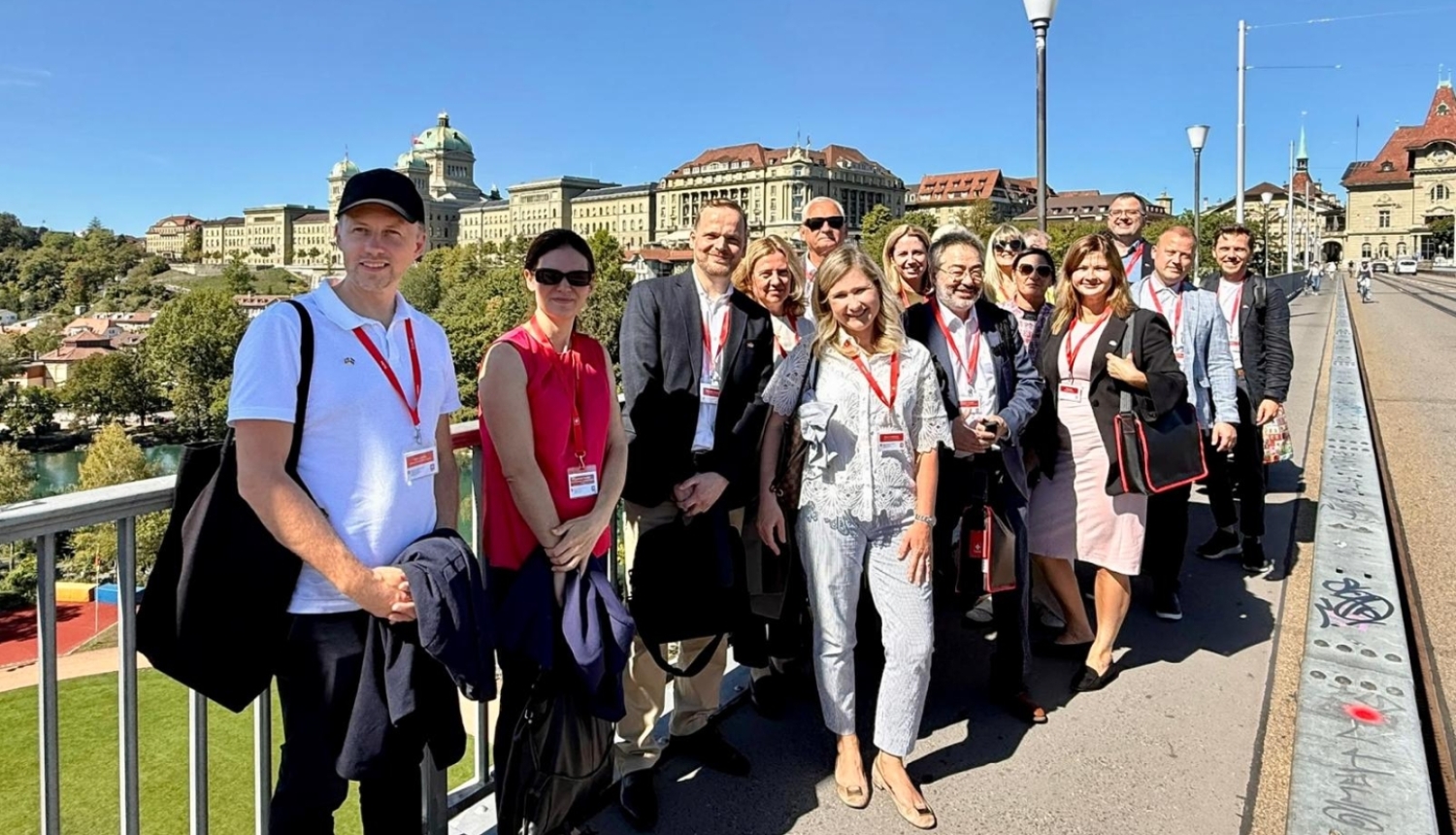
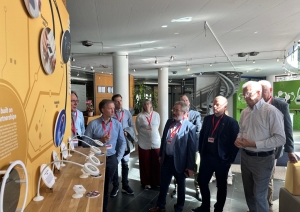
From 14 to 17 September, representatives of Latvia’s public administration, research institutions and industry took part in an experience-exchange visit to Switzerland focusing on the commercialisation of research results and effective collaboration between research and industry. During the visit, the Latvian delegation explored Swiss experience and different approaches in these areas, while also sharing Latvia’s own experience, solutions and challenges.
The Latvian delegation included representatives of the Ministry of Education and Science, the Ministry of Economics, the Ministry of Finance, the Investment and Development Agency of Latvia, Riga Technical University, the Institute of Solid State Physics of the University of Latvia, the Institute of Electronics and Computer Science, LAU Infra Group, and the Association of the Latvian Chemical and Pharmaceutical Industry.
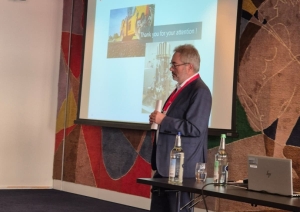
The four-day programme offered a rare opportunity to see in one place what is often spread across different institutions and policy areas in day-to-day practice: how research is funded, how companies engage in the development of new technologies, and what happens to research results once a project has ended. The Latvian delegation met representatives of the Swiss State Secretariat for Education, Research and Innovation (SERI), the Swiss Innovation Agency Innosuisse and the Swiss National Science Foundation, and visited the Swiss Center for Electronics and Microtechnology (CSEM), the Paul Scherrer Institute (PSI), Park Innovaare, the knowledge and technology transfer centre ANAXAM, the Zurich University of Applied Sciences (ZHAW), and the Swiss Federal Laboratories for Materials Science and Technology (Empa). Together, the visits provided insight into different stages of the same innovation chain - from policy and funding to industry collaboration, technology transfer and practical application.
An innovation system works when everyone invests in it
Latvia and Switzerland differ both in the scale of investment and in the capacity of companies to co-finance research and innovation. Nevertheless, Lauma Sīka, Deputy Director of the Higher Education, Science and Innovation Department at the Ministry of Education and Science, emphasises that, despite these differences, shared responsibility for innovation development is essential: “For us as policymakers, it was particularly valuable to gain an in-depth understanding of Switzerland’s system for supporting and financing science, innovation and technology transfer - from the perspective of Parliament and ministries, as well as that of Swiss research institutions themselves. Although the scale of investment and industry’s capacity to co-finance innovation differ between Switzerland and Latvia, one common lesson is that a vibrant innovation ecosystem requires investment from everyone, each at their own level - from the private sector and entrepreneurs to the public sector, from municipalities to the national level. Innovation does not advance without investment and effort, but the return comes in the form of new jobs, higher incomes, a more dynamic business environment and much greater confidence in the country’s long-term sustainability and growth”.
Incremental innovation matters too
The visit also highlighted the importance of incremental innovation. The economic value of an innovation is not always determined by its scale: even relatively small improvements within companies can, collectively, make a significant contribution to productivity and competitiveness. Equally important is how a country views investment in science and innovation and the role it gives to ideas and initiatives originating from companies. The Swiss approach offered an interesting perspective in this regard. Vitālijs Skrīvelis, Chairman of the Board of the Association of the Latvian Chemical and Pharmaceutical Industry, says: “What particularly struck me in Switzerland was the way investment in science and innovation is viewed. It is not seen as funding for one individual sector, but as a deliberate, cross-sectoral investment in the country’s economic development and sustainability, supporting business initiatives through a bottom-up approach. A positive contribution to Swiss economic growth is regarded as almost the sole criterion for innovation support. Another important takeaway was the significance of incremental innovation - the value of innovation is not determined by scale alone, relatively small innovations within companies can also play an important role in economic development. In Switzerland, where 99.7% of companies are SMEs, the combined contribution of such innovations to productivity and competitiveness is highly significant. This is particularly relevant for Latvia as well, where SMEs account for around 99.8% of companies.”.
Bringing an idea to market takes more than funding
For an innovative idea to become a solution that can be used in practice, it needs an environment where a prototype can be developed, the technology can be tested, research infrastructure can be accessed, expert support is available, the right industry partner can be found and, perhaps most importantly, an honest answer can be obtained to the question: whether the solution can actually be put to use?
The delegation saw this critical stage between research and the market in several Swiss institutions. CSEM, for example, develops technologies together with industry; PSI helps research results reach companies; and ANAXAM gives businesses access to analytical methods and infrastructure that would be complex and costly for an individual company to establish on its own. Ilze Lore, Director of the Business Support Department at the Ministry of Economics, notes: “From the perspective of the Ministry of Economics, the most valuable aspect was Switzerland’s practical approach to organising innovation and technology transfer, where research, public support and industry demand are closely linked to economic outcomes. The experience of Innosuisse, CSEM, ANAXAM, ZHAW and Empa was particularly useful - with a strong emphasis on joint projects between companies and research partners, prototyping, testing, technology validation, demonstration infrastructure and a clear pathway from idea to market.
In Latvia’s future work and discussions, it would be useful to build on this approach by strengthening an industry-needs-driven technology transfer ecosystem, particularly by improving SME access to research expertise, pilot projects and international partners. The Swiss experience shows that innovation policy depends not only on the availability of funding, but also on high-quality partnerships, assessment of market potential and the ability to rapidly turn knowledge into solutions that can be used in practice.”.
Examples of such partnerships already exist in Latvia. LAU Infra Group works with research organisations by providing opportunities to test new solutions in real infrastructure and operating conditions, involving company specialists and providing access to equipment and mineral resources. The visit made it possible to compare this existing model of cooperation with Swiss practice and identify ways in which it could be developed further. Egita Dilba, Strategic Management Process Manager at LAU Infra Group, says: “One of the key benefits of the visit was the opportunity to see first-hand the innovation ecosystem developed in Switzerland, where public funding programmes and targeted support mechanisms encourage the practical use of research results and the development of innovations with business applications. It demonstrated that the cooperation already taking place between research organisations and companies in Latvia can be developed even further by involving companies at an early stage in the development, testing and practical evaluation of new solutions.
LAU Infra Group and other companies in the infrastructure sector already cooperate with research organisations, providing opportunities to test new solutions in real infrastructure assets and operating conditions, involving company specialists and providing access to equipment and mineral resources. The experience gained during the visit confirmed that this cooperation can be made even closer and more systematic, allowing the practical applicability of solutions to be assessed more thoroughly already during the development process and enabling researchers to receive high-quality feedback”.
Customers and practical applications should be identified early
The journey of a research result to the market does not begin once the technology is already complete. The earlier it is possible to understand who will need the solution, the environment in which it will operate and the requirements of its potential users, the greater the chances of successfully developing the research result further. Andris Anspoks, Director of the Institute of Solid State Physics of the University of Latvia, emphasises: “Switzerland’s success is based on long-term investment in the development of science-based innovation. Along this path, every idea needs a customer and a clear objective - commercialisation - from the very beginning. For the process to bear fruit, patience and continuous development are needed, based on trust and the freedom to make mistakes. The Swiss example shows that this works. Latvia has the same opportunity: to invest today in technologies that will shape our exports and competitiveness ten years from now.”.
Maira Indrikova, Vice-Rector for Research at Riga Technical University, says: “Switzerland is a country from which we can learn a great deal about how to innovate successfully. One of the key prerequisites is close cooperation between industry and universities from the early stages of research. This visit was genuinely inspiring for me - it brought new insights, valuable contacts and shared ideas for future projects. I am pleased to have had the opportunity to meet so many like-minded people and to continue building cooperation that can grow into real solutions.”.
Technology transfer needs a system, not just individual partnerships.
Individual cooperation between a researcher and a company is not enough. For such models of cooperation to work consistently, clear mechanisms are also needed to manage intellectual property, organise technology transfer, connect partners and help research results move forward. Modris Greitāns, Director of the Institute of Electronics and Computer Science, emphasises: “The visits to CSEM, PSI, ZHAW and Empa were an excellent opportunity to see first-hand how Switzerland has built a research and innovation ecosystem that closely connects science, the public sector and industry. It was particularly valuable to see how not-for-profit research institutes based on public-private partnerships operate, as well as how intellectual property management and technology transfer are organised in a straightforward and effective way. Switzerland’s success in fostering the growth of high-tech companies, including innovative SMEs, shows that this approach works. This experience is highly valuable for Latvia - there is much we could learn from and adapt, both in the development of research and innovation policy and in the organisation of institutional cooperation, technology transfer and knowledge commercialisation”.
The visit not only provided an opportunity to compare Latvian and Swiss approaches, but also highlighted several issues for further discussion in Latvia - how to involve companies earlier in the research process, how to strengthen cooperation between research, industry and the public sector, and how to make fuller use of the potential of incremental and relatively small-scale innovation.
The experience-exchange visit was organised within the framework of the Swiss–Latvian Cooperation Programme “Partnership in Applied Research: Innovative Materials, ICT and Smart Energy”. The programme promotes cooperation between Latvian and Swiss research institutions in applied research and supports the practical application of research results.
Further information about the Programme is available here: https://swiss-contribution.lv/en/applied-research/news/