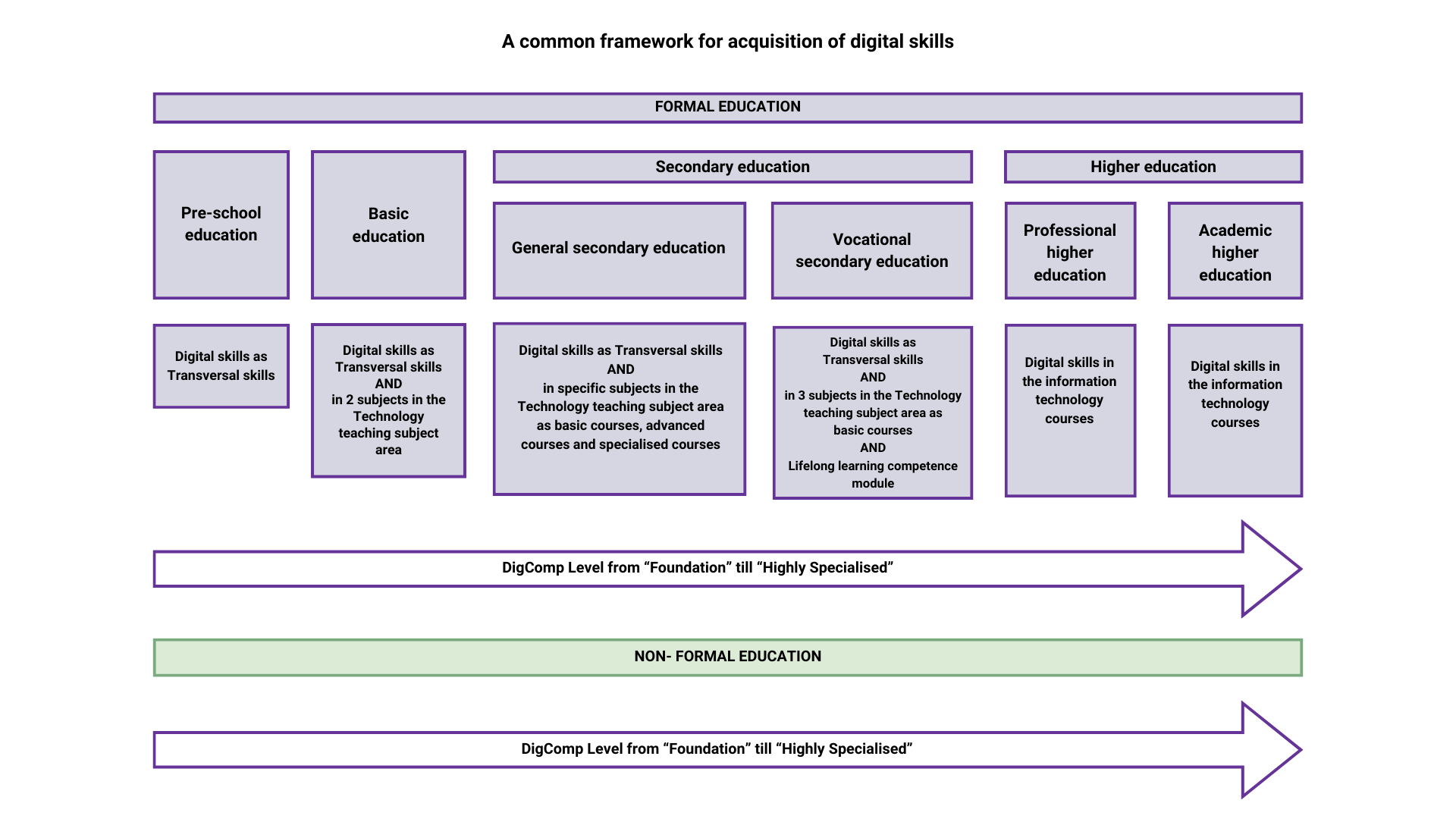
The key competences, including digital competency, are developed throughout life, through formal, non-formal and informal learning in different environments, including family, school, workplace, neighbourhood and other communities[1]. All key competencies, including digital, are transversal by its nature[2].
While formal education is strictly characterised by state-defined requirements for the education provider, content and implementation process, in return for issuing a state-recognised document on learning outcomes (education document or professional qualification), non-formal education is more flexible by its nature. It is planned by an education provider. The content and planned learning outcomes are defined by the educational provider, who also certifies the achieved learning outcomes. Non-formal education can cover programmes contributing to adult and youth literacy, as well as programmes on life skills, work skills, and social or cultural development[3]. Adults who have finished the formal education in the past, when digital technologies were not yet widespread in everyday life or in education, and digital literacy was not integrated into the education content as a cross-cutting competence more often acquire or develop their digital skills in the form of non-formal education. Therefore, it was important that all levels and forms of education have the same approach to defining digital learning outcomes, especially in non-formal education.
In Latvia, the development of digital skills takes place comprehensively within the entire education process, starting from the formal education in the pre-school and giving pupils the opportunity to both learn and also practically use digital skills throughout the learning process and following the non-formal education if deemed necessary. Upon completion of the specific level of formal education, graduates have acquired comprehensive digital skills literacy.
The Education Development Guidelines 2021-2027 envisages the development and implementation of the common framework for criteria in non-formal education and a revision of the higher education standard by supplementing with the determination of appropriate digital skills learning outcomes.
In 2006, reforms in the content of primary education and in 2008 in the content of general secondary education were initiated In Latvia, and in 2012, by developing pre-school education guidelines, the movement towards formal education that meets modern requirements was started. A formal education is a system which includes the levels of basic education, secondary education, and higher education the completion of the programmes of which is attested by an education or professional qualification document recognised by the State.
During the planning period 2014-2020 in the education system of Latvia a stable foundation has been created to ensure a modern and high-quality education. The most significant changes were the introduction of the competence approach in the curriculum (Skola2030) in general education. The new approach of teaching and learning content in the general education starting from pre-school till secondary school was developed, approved, successively introduced with main aim to facilitate pupils to acquire the knowledge, skills and attitudes necessary for today’s life. This is the first time that the content and approach to learning is structured in a unified system and successively in all levels of formal education of children and young people, starting from one and a half year old children in preschool and up to 18 years of age. The education standard of School 2030 (Skola 2030) has been created by focusing on the most essential learning content for the student, to develop proficiency (competence) as a complex result of the student's learning over a longer period of time (in preschool, 1-3, 4-6, 7-9, in grades 10-12).
Nowadays the non-formal education is gaining more and more importance in the development of skills, which is especially important for the acquisition of transversal skills such as digital skills and allows to respond promptly to the educational needs of the individuals and facilitate the quick achievement of necessary results. Issue on acquiring the basic digital skills in the non-formal is especially topical for those who did not have the opportunity to learn digital skills at a sufficient level in the general education. To ensure that the implementation of non-formal education programmes efficiently addresses topical education needs in society the political commitment was needed, which included amendments to the Education Law (Section 46) and delegation to the Cabinet of Ministers to develop the Regulation (Section 14, clause 111). Until 2023 there was no general regulation for the non-formal education in Latvia. The non-formal education is regarded as a logical continuation of the formal education based on the principles of learning outcomes already successfully implemented in the formal education. To ensure the introduction of the learning outcomes also to the non-formal education the common quality principles for the development and implementation of non-formal education programs have been developed.
Digital skills in the formal education
In the framework of formal education, digital skills are learned both as transversal skills and within a specific teaching subject area. In the formal education standard, digital skills are defined as one of the six transversal skills as well those skills are learned and applied within the framework of the Technology teaching subject area which is one of the seven learning areas of the formal education standard. In general, as the results of the learning the student responsibly uses digital technologies daily to acquire, use and create knowledge, as well as solve tasks and problems, share and use content created by himself and others, skilfully manages his digital identity, communicates effectively and safely and cooperates with others in the digital environment; critically and constructively evaluates the role of technology and media in society. Implementation of the new education content started from school year 2019/2020 at the pre-school, followed gradually at all grades of general education from the school year 2020/2021 and vocational secondary education from 2022. Starting from school year 2022/2023 the new education content is mandatory at all levels of formal education.
The following information provides an overview of other elements of the overall framework for assessment of digital skills, identification of learning needs, planning and evaluation based on the approach of the framework of the Digital Competences of European citizens (DigComp) at different levels of formal education in Latvia:
- Pre-school - Regulations on National pre-school Education Guidelines and Sample Pre-school Education Programmes (adopted on 21.11.2018.). During the pre-school education the child learns to distinguish the virtual world from the real world and understand the role of digital technologies, knows the rules to be followed when using various media, including digital devices.
- Basic education (EQF level 1-2) - Regulations Regarding the State Basic Education Standard and Model Basic Education Programmes (adopted on 27.11.2018.), where it is stipulated that the mandatory content of the basic education includes the transversal skill: "digital literacy" assuming that the learner uses digital technologies responsibly and efficiently for the acquisition of knowledge, the creation of new content, the sharing of the content and for the communication, critically and constructively assesses the role of technologies and media in the society. Annex 1 of the legal act stipulates the planned results to be achieved by learner in digital literacy at the end of the 9th grade including information and data literacy such as critically analyses the reality created by the media and the reliability of information, communication such as responsible use of digital communication for specific purposes, evaluating its suitability for the needs of the target group, digital content creation, safety such as control and manage his/her digital identity etc. Three subjects in the framework of the Technology teaching subject area are provided: Computer science – from Class 1 with an increased number of hours; Engineering in grade 7; Design and technologies in grades 1-9.
- General secondary education (EQF level 3-4) - Regulations Regarding the State General Secondary Education Standard and Model General Secondary Education Programmes (adopted on 03.09.2019.), where it is stipulated that the mandatory content of the general secondary education includes a transversal skill: "digital literacy"; the legal act stipulates compulsory content of the general secondary education, intended results of the acquisition thereof in the fields of study, and principles for the implementation. Annex 1 of the legal act stipulate the planned results to be achieved by the learner for the transversal skill: "digital literacy" at the end of the 12th grade. The content of the Technology subjects area are following: Computer science or Programming I and II and/or Design and technologies I and II and several new optional courses were introduced such as Robotics, Digital Design, etc.
- Vocational secondary education (EQF level 4) - Regulations on the national vocational secondary education standard and the national vocational education standard (adopted on 02.06.2020.); The vocational education contains the part of general education where the Standard of general secondary education is applicable and vocational education part where it is stipulated that one of the main tasks of the vocational secondary education is to develop the skills to constantly and independently to improve one's professional qualification as the response to the dynamic changes in society and the labour market, with particular attention to the use of digital technologies in work processes and service provision. Digital skills as a lifelong learning competence module with reference to level of competence are included in the vocational education program samples.
- Higher education - Regulations on the state standard of professional higher education (adopted on 13.07.2023.) which entered in force on 21 June, 2023; replacing Regulations of the Cabinet of Ministers No. 803, as amendments to the Regulations of the Cabinet of Ministers No. 512 of the August 26, 2014 “Regulations on the state standard of second-level professional higher education” adopted on 22.12.2022.; and Regulations of the Cabinet of Ministers No. 802 as amendments to the Regulations of the Cabinet of Ministers No. 141 of March 20, 2001 "Regulations on the state standard of first-level professional higher education; adopted on 22.12.2022. and Regulations on the state academic education standard (adopted on 13.05.2014. with amendments adopted on 22.12.2022. on strategic targets of study programmes). In both documents there is stipulated that one of the main tasks of the study programme is to provide that the graduates of each study programme can responsibly and safely choose and apply/ use information technologies in their professional activities, research, and lifelong learning, as well as the graduates, can acquire, create and share digital content. The mapping of the planned study results is used when developing the study tasks, including the acquisition of digital skills and competencies in various study courses and/or study modules, updating the study courses or modules providing that the planned study results are achieved according to the revised goals of a study programme.
Digital skills in the non-formal education
In accordance with the provisions of Education Law (Section 14, clause 111 and Section 46, which entered into force on 11 October 2022), the non-formal education were expanded to all age groups (previously were only adult non-formal education programmes), and definition of the non-formal education programme was provided stipulating that non-formal education programmes provide an opportunity for a person throughout his or her life, regardless of previously acquired education, to acquire new competences and to develop existing competences in accordance with the interests of personal development and the demands of the State or an employer. It should be noted that the main purpose of the non-formal education is to provide the learner with the necessary knowledge, skills, abilities, and attitudes as quickly and flexibly as possible, as well as to promote person’s comprehensive development and social inclusion. The non-formal education is a supplement to the formal education but does not replace it and in the non-formal education the quality requirements of formal education (such as standard etc.) are not applicable.
Recently a unified approach to identify and evaluate basic digital skills using levelling approach (defined as a combination of knowledge, skills, and attitudes) was only in formal education. But by approving the Regulation of the Cabinet of Ministers No. 395 "Procedure for issuing a permit for the implementation of the non-formal education programme" on 13 July 2023 the unified approach has been introduced also in the non-formal education. The Regulation of the Cabinet of Ministers filled in a missing part in terms of learning outcomes of a common framework as regards to the non-formal education. The common quality principles are applicable to all non-formal programs, including those for acquiring the digital skills. And in particular the digital skills the provisions for the assessment of basic digital skills, the identification and planning of training needs and the assessment based on Digital Competence Framework for Citizens (DigComp 2.1.) are included as mandatory condition. The legal act stipulates rules for structuring the planned learning outcomes according to the levels of the DigComp while the Annex of the Regulations of the Cabinet of Ministers includes descriptions of levels thus establishing a common framework for the assessment of basic digital skills, the identification and planning of training needs and the assessment based on the DigComp.
https://op.europa.eu/en/publication-detail/-/publication/297a33c8-a1f3-11e9-9d01-01aa75ed71a1/language-en
Ibid
https://uis.unesco.org/en/glossary-term/non-formal-education